Joy & Harmony
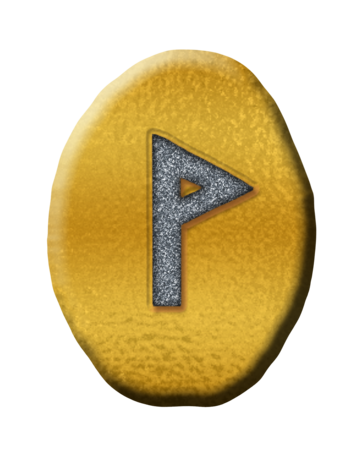
Wunjo is bliss, the rune of joy, harmony and fulfilment. It announces that a wish is ripening and that concord and belonging carry you. Today, allow yourself to rejoice in what is beautiful, and share that happiness with those close to you.
‘Wunjo’ is bliss, joy, concord – linguistically related to the German ‘Wonne’ and the English ‘win’. It stands for happiness and harmony in the community.
The Old English poem says, in essence: joy is enjoyed by the one who knows little sorrow, pain and grief and lives in prosperity and security.
Wunjo closes the first of the three groups of eight (Freyr’s aett) – a reconciling conclusion after strength, protection and the journey.
Like Gebo, Wunjo too belongs only to the Elder Futhark; in the 16-rune row of the Viking Age it is no longer included.
Wenne bruceþ ðe can weana lyt, sares ond sorge, ond him sylfa hæfþ blæd ond blysse ond eac byrga geniht.Bliss he enjoys who knows little of woe, pain and sorrow, and has for himself prosperity and happiness and enough in a strong house.Old English Rune Poem, st. 8 · trans. after Dickins 1915 (public domain)
Like Gebo, Wunjo did not survive into the Younger Futhark. The Old English poem is thus our only old voice – and it frames happiness soberly: not rapture but the absence of want, a safe roof, enough.
Proto-Germanic *wunjō „bliss, joy". Old English wynn, German „Wonne", cognate with „(ge)winnen" and „ween". The rune name Wynn also became a letter of the Old English alphabet (Ƿ) – one of the few runes to cross into the Latin script as a written character.
As the sound /w/ Wunjo is common in early inscriptions; in Old English writing the sign lived on as the letter wynn into the High Middle Ages before „w" replaced it. In the Elder Futhark rows it closes the first ætt.
Wunjo marks the end of Freyr’s ætt (runes 1–8). Its „joy/harmony" meaning, like Gebo’s, rests on the Old English poem alone; scholarship takes it as secure but notes the narrow source base (Dickins; Barnes).
Rune-poem quotation: Old English Rune Poem after Bruce Dickins, Runic and Heroic Poems (Cambridge 1915, public domain); Norse stanzas after the Norwegian and Icelandic Rune Poems. Interpretation & etymology after R. I. Page (Runes), Michael Barnes (Runes – A Handbook) and Klaus Düwel (Runenkunde). Where name or meaning is disputed, it is noted in the text. In depth: runology overview.