Lot-cup & Fate
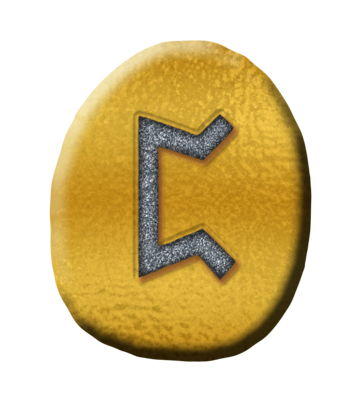
Perthro is the lot-cup, the rune of fate, of mystery and of hidden fortune. It speaks of the play of possibilities and of the fact that not everything lies in our hands. Stay open to surprises – the hidden reveals itself in its own time.
The meaning of ‘Perthro/Peorð’ is disputed to this day. The most convincing interpretation is as a dice- or lot-cup – the implement of play and of consulting fate.
The Old English poem links ‘peorð’ with play and laughter in the hall, where merry men sit together – a hint at dice-games and pastime.
The casting of lots and staves to consult fate is attested for the Germanic peoples as early as Tacitus. Perthro is the rune of the hidden, of the lot, of chance that is at the same time fate.
Perthro is the most mysterious rune of the Futhark – not least because no one can any longer say for certain what its name originally meant.
Peorð byþ symble plega and hlehter wlancum, ðar wigan sittaþ on beorsele bliþe ætsomne.Peorð is ever play and laughter to the proud, where warriors sit blithely together in the beer-hall.Old English Rune Poem, st. 14 · trans. after Dickins 1915 (public domain)
What „peorð" literally means, no one knows for sure. The context (beer-hall, play, laughter) suggests a dice- or lot-cup – hence our reading „lot-cup, fate, the hidden".
The name *perþ- is one of the few truly unexplained rune names. Proposals range from „pear-tree" through „dice-box/gaming-piece" to a fruit name – none is secure. The rune rarely occurs in real words, which further clouds the reading.
Perthro stands in the Kylver futhark row but is very rare in inscriptions. Its form (a „cup" or „pouch" on the stave) has further fuelled the speculation about the lot-cup.
Perthro is the most honest boundary-stone of the rune lexicon: here secured knowledge ends. The common reading „lot/fate" is plausible but inferred only from the hall context of the poem (Page; Barnes). We mark that explicitly.
Rune-poem quotation: Old English Rune Poem after Bruce Dickins, Runic and Heroic Poems (Cambridge 1915, public domain); Norse stanzas after the Norwegian and Icelandic Rune Poems. Interpretation & etymology after R. I. Page (Runes), Michael Barnes (Runes – A Handbook) and Klaus Düwel (Runenkunde). Where name or meaning is disputed, it is noted in the text. In depth: runology overview.