Need & Will
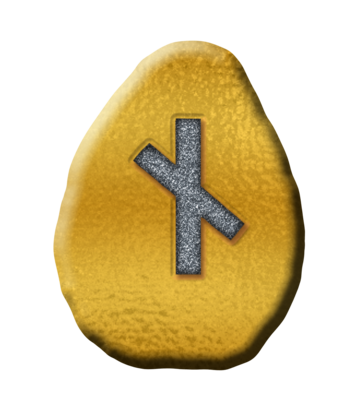
Nauthiz is need, constraint, but also the will that grows from it. It teaches patience and self-reliance and reminds us that the greatest strength often grows from want. Ask yourself what this challenge wants to teach you – and what inner strength it awakens in you.
‘Nauðr/Nyd’ is need, constraint, distress. Yet in the need lies also the will to overcome it.
The Old English poem says: need presses hard upon the breast – yet it often becomes a help and rescue to the children of men, if it is heeded in time.
The need-rune was considered powerful in defence; it stands for the fire-drill on which the need-fire is kindled – from want, through effort, comes the saving fire.
The image is striking: only pressure (the rubbing of two pieces of wood) brings forth the spark. Need as the midwife of strength.
Nyd byþ nearu on breostan; weorþeþ hi þeah oft niþa bearnum to helpe and to hæle gehwæþre, gif hi his hlystaþ æror.Need is oppressive to the heart; yet often it becomes for the children of men a help and healing, if they heed it in time.Old English Rune Poem, st. 10 · trans. after Dickins 1915 (public domain)
The Icelandic poem is bitterer: „Constraint is the grief of the bond-maid and a hard lot and toilsome work." The core stays: constraint that teaches – the need on which the will grows.
Proto-Germanic *naudiz „need, constraint, distress". Gothic nauþs, Old Norse nauð, Old English nyd, German „Not". A rare case where the rune name stays almost unchanged in sense over a millennium and a half.
As the sound /n/ Nauthiz is everywhere. In heroic verse (Sigrdrífumál) „need-runes" are named as protection – a literary witness to an ascribed magical use that must be kept apart from everyday writing.
Nauthiz shows the double message of many rune poems: need is an evil and a teacher. Runology reads such sayings as wisdom poetry, not oracle keys (Düwel; Dickins).
Rune-poem quotation: Old English Rune Poem after Bruce Dickins, Runic and Heroic Poems (Cambridge 1915, public domain); Norse stanzas after the Norwegian and Icelandic Rune Poems. Interpretation & etymology after R. I. Page (Runes), Michael Barnes (Runes – A Handbook) and Klaus Düwel (Runenkunde). Where name or meaning is disputed, it is noted in the text. In depth: runology overview.