Human & Self
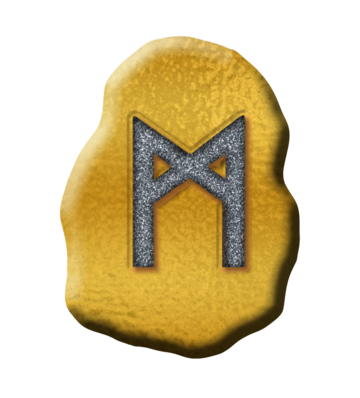
Mannaz is humankind, the rune of the self, of reason and of community. It calls you to know yourself and at the same time to respect your place among people. True greatness shows itself in measure – know yourself, and be a reliable presence to your own.
‘Mannaz’ is the human – related to the German ‘Mann’ and the English ‘man’. The rune stands for the self, the community and the place of the human in the world.
The Old Norse poem says soberly: ‘man is the joy of man’ – and also ‘the increase of the earth’. The Old English stresses how each is dear to the other, and yet each must one day leave the earth.
The human is conceived here not as an individual but as part of the kin. Mannaz reminds us that we first come to know ourselves in community.
The thought ‘man is man’s joy’ is found almost word for word in the Hávamál (stanza 47) – sociability as the highest good.
Man byþ on myrgþe his magan leof; sceal þeah anra gehwylc oðrum swican, forðum drihten wyle dome sine þæt earme flæsc eorþan betæcan.The joyous man is dear to his kinsmen; yet each must one day fail the other, for the Lord by his decree will commit the poor flesh to the earth.Old English Rune Poem, st. 20 · trans. after Dickins 1915 (public domain)
The Icelandic poem puts it laconically: „Man is the delight of man and the augmentation of the dust and the adorner of ships." Community and transience in one breath.
Proto-Germanic *mannaz „human, man". Old Norse maðr, Old English mann, German „Mann". Tacitus records the ancestor Mannus, son of the earth-born Tuisto – so the rune name carries an old founding-father myth within it.
In the Younger Futhark the old Algiz form took over the name maðr („man"). As the sound /m/ Mannaz is attested everywhere; its form (two staves with a cross-link) stands symbolically for people joining hands.
Mannaz unites social ethics and awareness of death – evidence that the rune poems are wisdom poetry, not fortune-telling formulas. The Mannus myth also makes it valuable for language history (Simek; Düwel).
Rune-poem quotation: Old English Rune Poem after Bruce Dickins, Runic and Heroic Poems (Cambridge 1915, public domain); Norse stanzas after the Norwegian and Icelandic Rune Poems. Interpretation & etymology after R. I. Page (Runes), Michael Barnes (Runes – A Handbook) and Klaus Düwel (Runenkunde). Where name or meaning is disputed, it is noted in the text. In depth: runology overview.