Ing & Ripeness
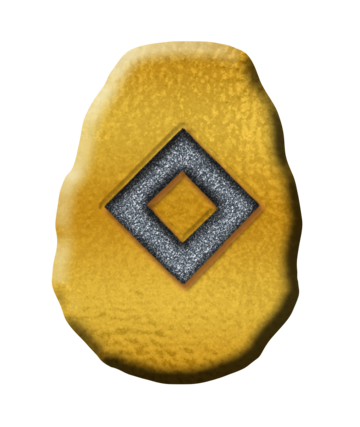
Ingwaz is the rune of the god Ing, an emblem of ripeness, completion and gathered power that is released. Like a seed that rests long and then sprouts, it speaks of the close of an undertaking. What has grown long may now bear fruit – rest in this completion.
‘Ingwaz’ is the rune of the god Ing (Yngvi-Freyr), the fertility god and forefather. It stands for ripening power, gathering and a happy conclusion.
The Old English poem tells how ‘Ing’ was first seen among the East Danes, then journeyed eastward over the waves – his wagon rolling after him. So the bold warriors named him.
Ing/Freyr stood for peace, good harvest and fertility; the Swedish royal line of the Ynglings derived its name from him. Ingwaz is the rune of stored, ripening energy.
The closed, diamond-shaped form of the rune looks like a seed or an enclosed field – power that gathers before it breaks forth.
Ing wæs ærest mid East-Denum gesewen secgun, oþ he siððan est ofer wæg gewat; wæn æfter ran; ðus Heardingas ðone hæle nemdun.Ing was first seen by men among the East-Danes, till he later departed eastwards over the wave; his wagon ran after; thus the Heardingas named the hero.Old English Rune Poem, st. 22 · trans. after Dickins 1915 (public domain)
Ing is the god Yngvi-Freyr, ancestor of the Swedish Ynglings and of the Ingaevones named by Tacitus. The rune preserves one of the oldest Germanic tribal and royal myths.
Proto-Germanic *Ingwaz, a fertility and ancestor god (later equated with Freyr). The name is embedded in Ingaevones (Tacitus) and in the royal line of the Ynglingar. The sound value is the nasal /ŋ/ (ng).
Ingwaz has a striking diamond or chain form. It dropped out of the Younger Futhark (the ng sound was written otherwise) but is firmly attested in the Elder Futhark and the Anglo-Saxon Futhorc.
The Ing stanza is a stroke of luck: it links a rune directly to a god and a migration legend (East-Danes → eastwards over the sea). Scholarship reads in it an old Freyr/ancestor cult (Simek; North).
Rune-poem quotation: Old English Rune Poem after Bruce Dickins, Runic and Heroic Poems (Cambridge 1915, public domain); Norse stanzas after the Norwegian and Icelandic Rune Poems. Interpretation & etymology after R. I. Page (Runes), Michael Barnes (Runes – A Handbook) and Klaus Düwel (Runenkunde). Where name or meaning is disputed, it is noted in the text. In depth: runology overview.