Yew & Backbone
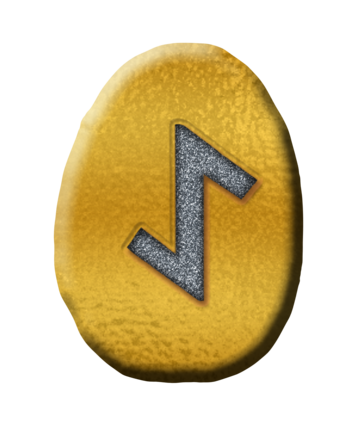
Eihwaz is the yew, the evergreen world tree that joins beginning and end. It stands for steadfastness, transformation and the deep backbone that carries you even through dark places. Rooted and yet changeable – so today you may trust your path, even when it leads through shadow.
‘Eihwaz’ is the yew – a tree that grows ancient, stays evergreen, and whose wood is at once poisonous and tough. The best bows were made from yew wood.
The Old English poem describes the yew as a tree rough on the outside, firmly rooted in the ground, keeper of fire, a joy on the homestead.
The yew was regarded as a tree between life and death – evergreen and yet poisonous. Some see in it an emblem of Yggdrasil itself. Eihwaz stands for backbone, endurance and the connection of above and below.
Yew bows were Europe’s high-performance weapon for over a thousand years – the material behind this rune decided battles.
Eoh byþ utan unsmeþe treow, heard hrusan fæst, hyrde fyres, wyrtrumun underwreþyd, wyn on eþle.The yew is a rough tree without, hard, fast in the earth, a keeper of fire, propped by its roots, a joy in the homeland.Old English Rune Poem, st. 13 · trans. after Dickins 1915 (public domain)
The yew is evergreen and ancient – a tree that binds beginning and end; some link it to Yggdrasil. Its wood made the finest bows (Old Norse ýr = yew and bow).
Proto-Germanic *īhwaz / *īwaz „yew". Old Norse ýr, Old English eoh/īw, German „Eibe". The sound value is uncertain – often transliterated ï or æ, an „in-between" sound. Eihwaz is among the rarest and most puzzling runes.
Eihwaz is attested on the Kylver stone and in a few early rows, but hardly appears in real words – partly because its sound was unusual. In the Younger Futhark it vanished in this form.
Eihwaz is a model case of runological uncertainty: unclear sound value, rare attestations, hardly any secure words. For that very reason scholarship warns against over-confident „meanings" (Barnes; Looijenga).
Rune-poem quotation: Old English Rune Poem after Bruce Dickins, Runic and Heroic Poems (Cambridge 1915, public domain); Norse stanzas after the Norwegian and Icelandic Rune Poems. Interpretation & etymology after R. I. Page (Runes), Michael Barnes (Runes – A Handbook) and Klaus Düwel (Runenkunde). Where name or meaning is disputed, it is noted in the text. In depth: runology overview.