Day & Breakthrough
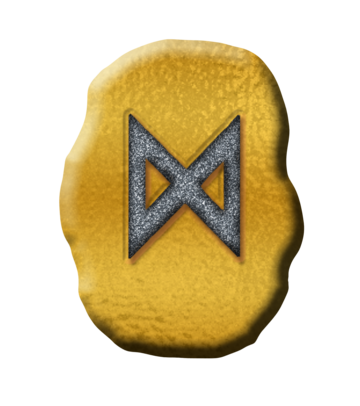
Dagaz is the day, the morning light between night and day, the rune of breakthrough, awakening and hope. It promises that darkness turns to light – a change for the good, a clear moment of insight. Today a door opens; step through it with confidence.
‘Dagaz’ is the day, the daylight – related to the German ‘Tag’. Rune of breakthrough, of the turn from dark to light.
The Old English poem praises the day as the Lord’s sending, dear to people, glorious light, joy and hope for rich and poor, useful to all.
The change from night to day, from dusk to morning, was a fundamental experience – Dagaz marks exactly this moment of turning, in which everything clears.
Some rune rows place Dagaz at the end of the Futhark – as a hopeful conclusion: after all the dark, the new day.
Dæg byþ drihtnes sond, deore mannum, mære metodes leoht, myrgþ and tohiht eadgum and earmum, eallum brice.Day is the Lord’s messenger, dear to men, the glorious light of the Creator, joy and hope to rich and poor, of use to all.Old English Rune Poem, st. 23 · trans. after Dickins 1915 (public domain)
Dagaz did not survive into the Younger Futhark. The Old English poem celebrates the dawn: breakthrough, awakening, the tipping of dark into light.
Proto-Germanic *dagaz „day". Old Norse dagr, Old English dæg, German „Tag". In the Edda Dagr (Day) is the shining son who rides a bright horse around the sky – so the rune name also carries a mythic image.
The d-rune has a striking loop or hourglass form. It is firmly attested in the Elder Futhark and the Futhorc; in the Younger Futhark the d sound was written with the t-rune.
Dagaz and Othala close the futhark (runes 23–24; the order varies in some sources). The „day/breakthrough" reading is well founded and constant across the rows (Dickins; Barnes).
Rune-poem quotation: Old English Rune Poem after Bruce Dickins, Runic and Heroic Poems (Cambridge 1915, public domain); Norse stanzas after the Norwegian and Icelandic Rune Poems. Interpretation & etymology after R. I. Page (Runes), Michael Barnes (Runes – A Handbook) and Klaus Düwel (Runenkunde). Where name or meaning is disputed, it is noted in the text. In depth: runology overview.