Protection & Elk
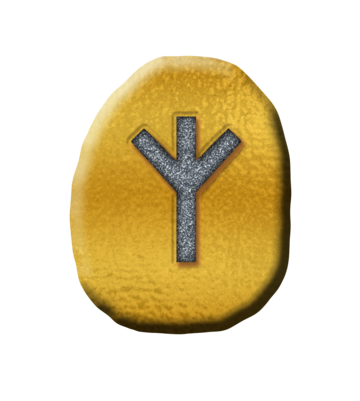
Algiz is protection, the raised elk-antler, the rune of safekeeping and watchful instinct. It lays a sheltering hand over you and advises listening to your gut feeling. Today you may feel secure – and at the same time be alert to where a boundary is needed.
‘Algiz/Elhaz’ is usually interpreted as ‘elk’, sometimes as protection or as the sharp-edged sedge. The upward-splayed form recalls a warding hand or an antler.
The Old English poem speaks of the ‘eolh’ sedge that grows in the marsh and cruelly wounds anyone who grasps at it – a natural protection through defensiveness.
Algiz is regarded as the classic protective rune, a sign of warding and preservation. Its form also appears inverted as a ‘death rune’ in later interpretations.
The upright Algiz form is today one of the best-known runic signs of all – as an emblem of protection and life.
Eolh-secg eard hæfþ oftust on fenne, wexeð on wature, wundaþ grimme, blode breneð beorna gehwylcne ðe him ænigne onfeng gedeþ.The elk-sedge has its home most often in the fen, grows in the water, wounds grimly and stains with blood each man who grasps at it.Old English Rune Poem, st. 15 · trans. after Dickins 1915 (public domain)
The Old English poem names a cutting sedge; the rune name is usually read as *algiz „elk" (protection). Both images meet in „defence" – the sharp plant like the wary animal.
Proto-Germanic *algiz „elk" – or the name of the cutting „elk-sedge" (OE eolh-secg). The sound value is the final sibilant -ʀ (from earlier /z/), a special sound that occurred only word-finally. In the Younger Futhark the rune was reused as the sign for maðr („man").
As the ʀ-rune Algiz stands above all word-finally – e.g. in the ending of names like HlewagastiR (Gallehus). Its upward-spread form („raised hand/antlers") made it a favourite protective sign in modern times.
Algiz shows two things at once: the fine Germanic sound history (the /z/→/ʀ/ shift) and the reuse of runes (ʀ→man-rune). The modern „protective rune" rests on the elk/defence reading – historically plausible but elaborated (Antonsen; Barnes).
Rune-poem quotation: Old English Rune Poem after Bruce Dickins, Runic and Heroic Poems (Cambridge 1915, public domain); Norse stanzas after the Norwegian and Icelandic Rune Poems. Interpretation & etymology after R. I. Page (Runes), Michael Barnes (Runes – A Handbook) and Klaus Düwel (Runenkunde). Where name or meaning is disputed, it is noted in the text. In depth: runology overview.