Primal Strength & Health
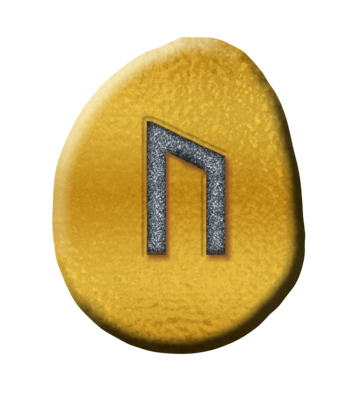
Uruz carries the untamed strength of the aurochs, the wild primal ox of the northern forests. It is the rune of raw life energy, health and courage – the call to embrace your own strength and to withstand obstacles rather than avoid them. Where might you step up more powerfully and resolutely today?
‘Ur’ is the aurochs, the mighty wild ox that roamed Europe’s forests into the early modern age. The rune embodies raw, untamed life force and health.
The Old English poem describes the ‘ur’ as a brave, horned beast that strides wildly across the moor – an emblem of unbroken strength. In the Old Norse poem, by contrast, ‘úr’ stands for drizzle and slag, a hint of how greatly the interpretations varied by region.
The aurochs was seen as a test of manhood; its horns were made into drinking horns. The rune carries this notion of primordial strength onward.
The last known aurochs died in 1627 in Poland – so the animal behind this rune is in fact extinct.
Ur byþ anmod ond oferhyrned, felafrecne deor, feohteþ mid hornum, mære morstapa; þæt is modig wuht.The aurochs is proud and high-horned, a very fierce beast; it fights with its horns, a famous roamer of the moor – a creature of courage.Old English Rune Poem, st. 2 · trans. after Dickins 1915 (public domain)
Strikingly, the same rune means something quite different in the North. The Icelandic poem reads úr as „drizzle/slag", the Norwegian as „dross from iron". The wild aurochs of the southern Germani has become fine rain in the North – a textbook case of how rune names drift.
Proto-Germanic *ūruz denotes the aurochs (Bos primigenius), the mighty wild ox of Europe’s forests, which died out only in the 17th century. Cognates are Old High German ūro and Old Norse úrr. The Norse reinterpretation as „úr" (wet, slag) shows the sound value /u/ stayed fixed while the name was refilled.
Uruz sits firmly as the second sign in the futhark rows of Kylver and Vadstena. As the sound /u/ it appears in many early inscriptions; its clear two-stroke form is among the least changed runes across the whole Elder Futhark period.
Scholars treat Uruz as a good example of the „acrophonic" build of the futhark: the rune name begins with the sound the rune stands for. The meaning-shift aurochs → drizzle between the rune poems is a warning – the „meaning" of a rune is bound to time and region (Düwel; Page).
Rune-poem quotation: Old English Rune Poem after Bruce Dickins, Runic and Heroic Poems (Cambridge 1915, public domain); Norse stanzas after the Norwegian and Icelandic Rune Poems. Interpretation & etymology after R. I. Page (Runes), Michael Barnes (Runes – A Handbook) and Klaus Düwel (Runenkunde). Where name or meaning is disputed, it is noted in the text. In depth: runology overview.