Tyr & Justice
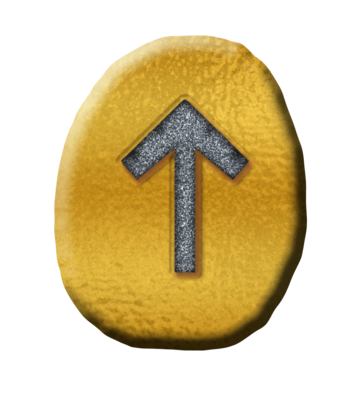
Tiwaz is the rune of the sky god Tyr, who sacrificed his hand to bind the wolf Fenrir. It stands for courage, honour, justice and the victory won through righteousness. Where uprightness matters today, it gives you steadfastness – a given word weighs more than an advantage.
‘Tiwaz’ is the rune of the god Tyr – the old god of sky and war, who stands for law, order and self-sacrifice. The form resembles an upward-pointing arrow or spear.
The Old Norse poem calls ‘Tyr’ the one-handed god and compares him to the guiding star that holds its place in the sky while everything circles around it – an emblem of reliability.
Tyr sacrificed his right hand so that the gods could bind the wolf Fenrir – justice that costs something. Tiwaz was carved on weapons to ask for victory and a just verdict.
‘Tuesday’ bears his name: English ‘Tuesday’, from Tiw/Tyr – as Thursday is from Thor and Wednesday from Woden.
Tir biþ tacna sum, healdeð trywa wel wiþ æþelingas; a biþ on færylde ofer nihta genipu, næfre swiceþ.Tir is a (guiding) sign; well does it keep faith with princes; ever on its course over the mists of night, it never fails.Old English Rune Poem, st. 17 · trans. after Dickins 1915 (public domain)
The Icelandic poem names the god directly: „Týr is the one-handed god and leavings of the wolf and prince of temples." An allusion to the myth: Týr laid his hand in Fenrir’s jaws so the gods could bind the wolf – and lost it.
Proto-Germanic *Tīwaz, the sky- and war-god – etymologically the same word as Latin deus and Greek Zeus (PIE *dyeus „sky"). Old Norse Týr, Old High German Ziu: probably the oldest named Germanic god. His day is Tuesday („Tiw’s day").
The arrow-like t-rune is a victory sign: the Sigrdrífumál says one should „name Týr twice" to carve victory-runes. In the Kylver row Tiwaz opens the third ætt („Tyr’s ætt").
Tiwaz is the only Elder rune undisputedly named after a god – a rare fixed point in the reading of rune names (Düwel; Simek). The modern „war/victory rune" rests directly on this ancient tradition.
Rune-poem quotation: Old English Rune Poem after Bruce Dickins, Runic and Heroic Poems (Cambridge 1915, public domain); Norse stanzas after the Norwegian and Icelandic Rune Poems. Interpretation & etymology after R. I. Page (Runes), Michael Barnes (Runes – A Handbook) and Klaus Düwel (Runenkunde). Where name or meaning is disputed, it is noted in the text. In depth: runology overview.