Journey & Path
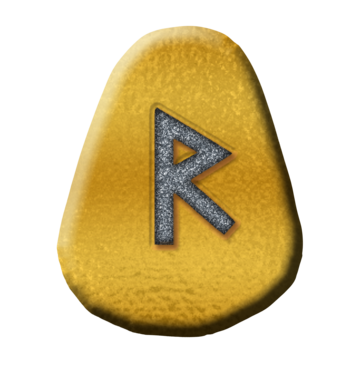
Raidho is the ride and the journey, the rune of movement in the right measure and at the right time. It speaks of setting out, of the path you walk, and of the rhythm that mediates between haste and rest. Trust that the road itself teaches you – every arrival begins with the first step.
‘Reið’ means ride, wagon and journey. Raidho is the rune of movement, of the path and of the right rhythm.
The Old English poem observes finely: riding is easy to talk about in the hall, but much harder for the one who must actually cover the long road on horseback. A reminder not to confuse talk with deeds.
In a world without roads, travel was perilous and meaningful; Raidho stood for setting out, pilgrimage and also the journey of the sun across the sky.
Some also interpret Raidho as cosmic order – the ordered course of the heavenly bodies by which the whole year is set.
Rad byþ on recyde rinca gehwylcum sefte ond swiþhwæt ðamðe sitteþ on ufan meare mægenheardum ofer milpaþas.Riding seems easy to every warrior in the hall, and very bold to him who traverses the mile-paths on a mighty steed.Old English Rune Poem, st. 5 · trans. after Dickins 1915 (public domain)
The Icelandic poem sharpens it: „riding is a blessing to the sitter, a speedy journey and the toil of the horse" – travel from three angles at once, for rider, road and steed.
Proto-Germanic *raidō „the ride, the journey, the wagon". Old Norse reið, Old English rād (→ English „road"), German „Reit-" and „bereit". The name is not just the horse but ordered motion – the right path in the right rhythm.
As the sound /r/ Raidho is one of the commonest runes. It sits in the ever-recurring verb raisidō / raisþi „raised" on hundreds of memorial stones („X reisti stone") – making Raidho literally the rune of the runestones.
The „journey/path" meaning is constant across all three rune poems – a rare agreement that makes the reading unusually secure (Dickins; Page). As an everyday sound, however, plain script use clearly dominates.
Rune-poem quotation: Old English Rune Poem after Bruce Dickins, Runic and Heroic Poems (Cambridge 1915, public domain); Norse stanzas after the Norwegian and Icelandic Rune Poems. Interpretation & etymology after R. I. Page (Runes), Michael Barnes (Runes – A Handbook) and Klaus Düwel (Runenkunde). Where name or meaning is disputed, it is noted in the text. In depth: runology overview.