Heritage & Home
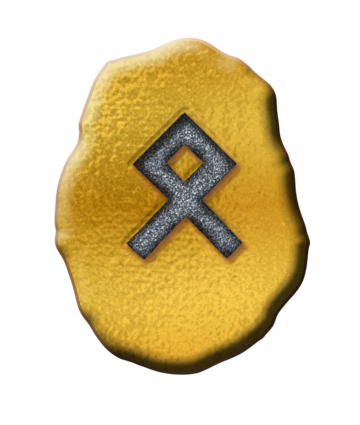
Othala is the heritage and the homestead, the rune of home, origin and inherited values. It recalls what endures and sustains: family, roots and what one passes on. Reflect today on your foundation – from it you draw stability and meaning.
‘Othala/Óðal’ is the inherited estate, the ancestral property, the homeland. Related to the German ‘Adel’ (originally: inherited property, noble descent).
The Old English poem says: the home (the inherited ground) is dear to everyone, if there, in righteousness, they may enjoy what is custom and constant.
Othala stands for home, family and what is passed down over generations – land and soil as well as values and memory. As the last rune of the Futhark, it closes the circle: from movable property (Fehu) to lasting heritage.
From beginning to end an arc is drawn: Fehu is the cattle one acquires – Othala the heritage one passes on. The wealth that endures is the wealth you leave behind.
Eþel byþ oferleof æghwylcum men, gif he mot ðær rihtes and gerysena on brucan on bolde bleadum oftast.The ancestral estate is very dear to every man, if he may there enjoy in his house whatever is right and fitting in constant plenty.Old English Rune Poem, st. 24 · trans. after Dickins 1915 (public domain)
Othala means the óðal – the inherited, free land of the kin. It did not survive into the Younger Futhark; the Old English poem preserves its sense: home, origin, that which endures.
Proto-Germanic *ōþala-/*ōþila- „inherited property, ancestral land". Old Norse óðal (cf. odal/allodial law), Old English eþel „homeland". The term denoted the inalienable land that binds generations – a core concept of Germanic law.
The o-rune (diamond or shield form) closes the Elder Futhark. Important: the „Odal rune" was misused as a symbol under National Socialism and still is in far-right circles today – this is a modern political appropriation, not the historical meaning „heritage/home".
Othala stands for the Germanic legal concept of ancestral land (Düwel; Simek). Its modern appropriation is historically baseless; anyone wearing or engraving the rune should know of this double reception – the old meaning is „inherited home", nothing political.
Rune-poem quotation: Old English Rune Poem after Bruce Dickins, Runic and Heroic Poems (Cambridge 1915, public domain); Norse stanzas after the Norwegian and Icelandic Rune Poems. Interpretation & etymology after R. I. Page (Runes), Michael Barnes (Runes – A Handbook) and Klaus Düwel (Runenkunde). Where name or meaning is disputed, it is noted in the text. In depth: runology overview.