Torch & Insight
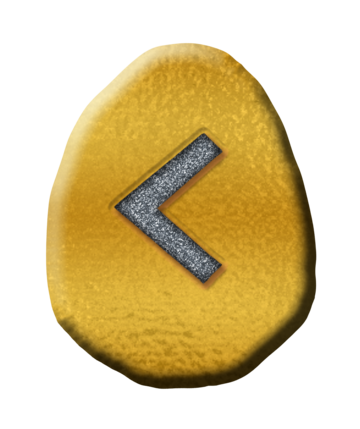
Kenaz is the torch in the dark, the rune of insight, craft and the creative flame. It grants clarity, skill and the ability to call something new into being. Today a light burns for you – use it to learn, to create and to make the hidden visible.
In Old English ‘cen’ is the torch, the pine-splint – light in the dark. In Old Norse it echoes ‘kaun’, the sore. From this tension comes the meaning: insight, skill, creative heat, but also that which hurts and burns.
The Old English poem describes the torch as a living fire that burns bright where the nobles sit together.
Kenaz is linked with craft and smithing – with the fire that forms metal and makes knowledge visible. For an engraving workshop, an especially fitting rune.
The same word lies in the English ‘ken’ (to know) and the German ‘kennen’ – light and knowledge lie close together in language.
Cen byþ cwicera gehwam cuþ on fyre, blac ond beorhtlic, byrneþ oftust ðær hi æþelingas inne restaþ.The torch is known to all the living by its fire, pale and bright; it burns most often where the nobles rest within.Old English Rune Poem, st. 6 · trans. after Dickins 1915 (public domain)
A sharp break with the North: there the k-rune is not „torch" but Kaun = „ulcer". The Icelandic poem: „ulcer is the bane of children and the house of rotting flesh". The southern light becomes a festering wound in the North – one rune, opposite images.
The Elder Futhark name is uncertain. Two traditions stand side by side: Old English cēn „pine-torch" (PG *kenaz) and Old Norse kaun „ulcer" (PG *kaunan). Some scholars posit „torch/fire" as the original sense, others leave it open – a model case of runological caution.
The k-rune changes form greatly (Elder <, Younger as a branch-sign), which further clouds its meaning. In the futhark rows of Kylver and Vadstena it keeps its sixth place; as the sound /k/ it is everywhere in names and formulas.
Kenaz shows exemplarily that „the one meaning" of a rune often does not exist. Runology documents both names (torch vs. ulcer) side by side and refuses false certainty (Barnes; Page). Modern readings „insight, skill" derive from „torch = light" – plausible, but modern.
Rune-poem quotation: Old English Rune Poem after Bruce Dickins, Runic and Heroic Poems (Cambridge 1915, public domain); Norse stanzas after the Norwegian and Icelandic Rune Poems. Interpretation & etymology after R. I. Page (Runes), Michael Barnes (Runes – A Handbook) and Klaus Düwel (Runenkunde). Where name or meaning is disputed, it is noted in the text. In depth: runology overview.