Year & Harvest
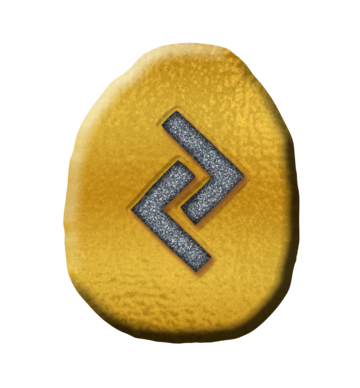
Jera is the good year, the rune of harvest and the natural cycle. It promises the reward of steady effort – what you have sown ripens when you give the course of things time. Good things take their time; today you may trust in the fruit of your patience.
‘Jera/Ger’ is the (good) year, the harvest, the cycle of the seasons. Related to the German ‘Jahr’ (year).
The Old English poem says: the year (the harvest) is the joy of people, when God lets the earth bring forth its fruits – for rich and poor alike.
Jera embodies the reward for patient work: sown in spring, harvested in autumn. Its form, with the two interlocking parts, depicts the eternal turning of the seasons.
No other rune is so much a promise: what you do in right measure bears fruit in its time.
Ger byþ gumena hiht, ðonne God læteþ, halig heofones cyning, hrusan syllan beorhte bleda beornum ond ðearfum.The (good) year is the hope of men, when God, the holy King of Heaven, lets the earth give bright fruit to rich and poor alike.Old English Rune Poem, st. 12 · trans. after Dickins 1915 (public domain)
In the Younger Futhark this sense lives on under the name Ár („good year"): „Plenty is a boon to men and a good summer and a fully ripened field" (Icelandic). Harvest as the reward of patience.
Proto-Germanic *jēran „year, (good) harvest". Gothic jer, Old Norse ár, Old English gēr/gear – whence English „year". Curiously the original sound value was /j/; in the Younger Futhark the (reshaped) rune moved to the sound /a/ (Ár).
Jera has a striking two-part form. It appears, among others, on the Vadstena bracteate in the row. The name-shift Jera→Ár is one of the finest witnesses to how sound value and sign re-couple.
Jera unites the history of language and of script in one sign: the same rune name became the English word „year", while in the North the rune changed its sound value (Barnes; Düwel). The „harvest/cycle" reading is constant across the rows.
Rune-poem quotation: Old English Rune Poem after Bruce Dickins, Runic and Heroic Poems (Cambridge 1915, public domain); Norse stanzas after the Norwegian and Icelandic Rune Poems. Interpretation & etymology after R. I. Page (Runes), Michael Barnes (Runes – A Handbook) and Klaus Düwel (Runenkunde). Where name or meaning is disputed, it is noted in the text. In depth: runology overview.