Ice & Stillness
Isa is the ice, the rune of standstill, of stillness and of the clarity that arises only in pausing. It advises forcing nothing, but waiting for the right moment – sometimes the waiting itself is the deed. In stillness you find today what haste conceals.
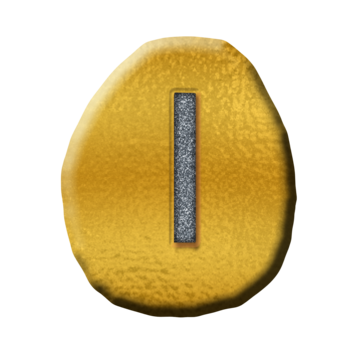
‘Is/Íss’ is ice. A single vertical line – the coldest, stillest, clearest of the runes.
The Old Norse poem calls ice ‘the broad bridge’; the Old English describes it as cold, slippery and glass-clear, beautiful to behold like a gem, a floor of frost.
Frozen rivers became paths and bridges in winter – the ice connected what otherwise divided. At the same time, Isa stands for standstill and rigidity.
Isa is the simplest of all rune forms: a single vertical stave. Stillness in its purest form.
Is byþ ofereald, ungemetum slidor, glisnaþ glæshluttur gimmum gelicust; flor forste geworuht, fæger ansyne.Ice is very cold and immeasurably slippery; it glistens clear as glass, most like gems; a floor wrought by the frost, fair to behold.Old English Rune Poem, st. 11 · trans. after Dickins 1915 (public domain)
The Norwegian poem gives a practical image: „Ice we call the broad bridge – the blind must be led." Beauty and danger at once: the ice both bears and betrays.
Proto-Germanic *īsaz „ice". Old Norse íss, Old English is, German „Eis". The name is transmitted unanimously; the rune itself is the plain vertical stroke – the simplest form in the whole futhark.
Because Isa is only a vertical stave, it often serves as a component of bind-runes and appears in nearly every longer inscription. As an ideograph it stands for standstill.
Isa shows how form and meaning cohere: the single stroke = standstill, clarity, pause. Runology holds this reading well founded, since it recurs in all three poems (Page; Dickins).
Rune-poem quotation: Old English Rune Poem after Bruce Dickins, Runic and Heroic Poems (Cambridge 1915, public domain); Norse stanzas after the Norwegian and Icelandic Rune Poems. Interpretation & etymology after R. I. Page (Runes), Michael Barnes (Runes – A Handbook) and Klaus Düwel (Runenkunde). Where name or meaning is disputed, it is noted in the text. In depth: runology overview.