
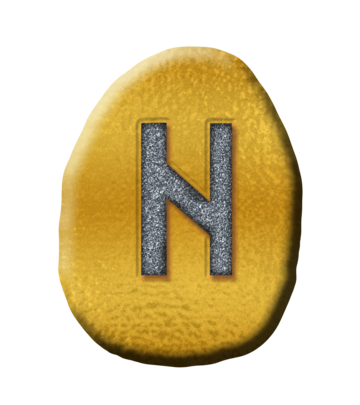
Hail & Change
Hagalaz is the hail that falls unexpectedly from the sky – a rune of sudden upheaval and trial. Yet the hail melts to water that nourishes: what breaks open now clears and makes room for the new. Meet change with composure, for it has its purpose.
‘Hagall’ is hail – the grain of ice that falls from the sky. Hagalaz opens the second group of eight and stands for sudden upheaval and the rough forces of nature.
The Old Norse poem calls hail ‘the coldest of grains’. The Old English adds to the image: hail is white, rolls from the sky, is driven by the wind – and in the end turns into water.
Hail destroys the harvest in minutes – yet the ice melts and becomes water that nourishes new growth. Hagalaz carries this double sense of destruction and transformation.
In some orderings, Hagalaz is regarded as the ‘mother rune’, from whose form the other runes can be conceptually derived.
Hægl byþ hwitust corna; hwyrft hit of heofones lyfte, wealcaþ hit windes scura; weorþeþ hit to wætere syððan.Hail is the whitest of grain; it whirls from the vault of heaven, gusts of wind toss it – then it turns to water.Old English Rune Poem, st. 9 · trans. after Dickins 1915 (public domain)
The Norwegian poem openly Christianises the rune: „Hail is the coldest of grain; Christ created the world of old." The Icelandic stays heathen and vivid: „Hail is cold grain and a shower of sleet and the sickness of serpents."
Proto-Germanic *haglaz „hail". Old Norse hagl, Old English hægl, German „Hagel". The name is constant across all rows – the sudden, hard turn of nature that destroys yet passes (hail becomes water). Hagalaz opens the second ætt, which is therefore called „Hagal’s ætt".
Hagalaz appears in two basic forms: the single-bar Scandinavian and the double-bar continental. In the Kylver futhark row it holds the ninth place. As the sound /h/ it is common in many inscriptions.
That of all texts the Norwegian poem brings in Christ is a prime example of how strongly the rune poems are already Christianised – the „meanings" are medieval mnemonic verses, not heathen revelations (Page; Barnes).
Rune-poem quotation: Old English Rune Poem after Bruce Dickins, Runic and Heroic Poems (Cambridge 1915, public domain); Norse stanzas after the Norwegian and Icelandic Rune Poems. Interpretation & etymology after R. I. Page (Runes), Michael Barnes (Runes – A Handbook) and Klaus Düwel (Runenkunde). Where name or meaning is disputed, it is noted in the text. In depth: runology overview.