Gift & Bond
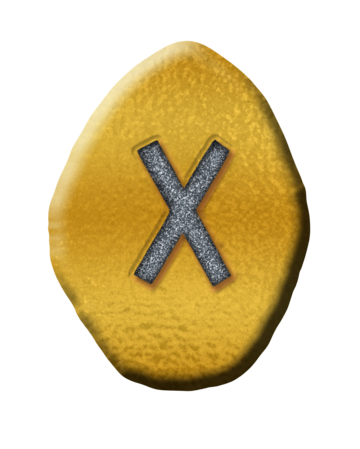
Gebo is the gift, the simple cross of giving and receiving. It stands for generosity, partnership and the bond that rests on reciprocity – giving and taking in balance. True connection arises where both sides give freely; pay attention to this balance today.
‘Gebo’ is the gift, the present. The rune has the form of a cross (X) – a sign of mutual giving and taking.
The Old English poem praises generosity: a gift brings a person standing and honour and helps the one who would otherwise have nothing.
In the Viking Age, gifts sealed alliances, hospitality and loyalty. Whoever gave, obligated – and created a bond. Gebo belongs only to the Elder Futhark and is missing from the later Viking row.
The Old Norse ideal ran: ‘a gift always calls for a return.’ Giving was no selfless act but a bond that tied people to one another.
Gyfu gumena byþ gleng ond herenys, wraþu ond wyrþscype, ond wræcna gehwam ar ond ætwist ðe byþ oþra leas.Generosity brings adornment and praise, support and worth; and to every outcast who has nothing else, honour and sustenance.Old English Rune Poem, st. 7 · trans. after Dickins 1915 (public domain)
A Norse counterpart is missing: Gebo did not survive into the 16-sign futhark. We know its sense only from the Old English poem – all the more reason to take it seriously.
Proto-Germanic *gebō „gift". Old English giefu, Gothic giba, German „Gabe/geben". The X-shaped sign stands for the mutuality of giving and taking – among the Germani a binding social act, not a mere exchange of goods (cf. Tacitus on the gift ethos).
Gebo carries one of the loveliest early blessing formulas: gibu auja „I give luck", attested on Migration-Period gold bracteates among others. As the sound /g/ it stands in many names; its clear X-shape makes it one of the easily recognised runes.
Because Gebo dropped out of the Younger Futhark, it is a test case for how much interpretation a single poem can bear. Runology reads it within the Germanic gift-exchange culture (do ut des) – a well-founded reading, but fed from one source (Page; Düwel).
Rune-poem quotation: Old English Rune Poem after Bruce Dickins, Runic and Heroic Poems (Cambridge 1915, public domain); Norse stanzas after the Norwegian and Icelandic Rune Poems. Interpretation & etymology after R. I. Page (Runes), Michael Barnes (Runes – A Handbook) and Klaus Düwel (Runenkunde). Where name or meaning is disputed, it is noted in the text. In depth: runology overview.