Wealth & Prosperity
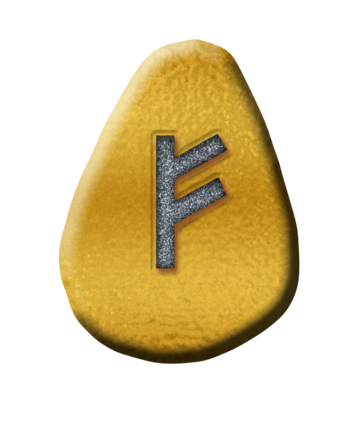
Fehu, the rune of cattle and gold, stands at the beginning of the Futhark and speaks of movable wealth that grows through diligence and good sense. It reminds us that prosperity only unfolds its true value in sharing and flowing – hoarded gold grows cold. Today it invites you to notice with gratitude what gives you abundance, and to pass it on generously.
The name literally means ‘cattle’ – and thus movable property, wealth, gold. In an age when prosperity was measured in cattle, Fehu was simply the rune of wealth. It is linguistically related to the German word ‘Vieh’ (livestock) and the English ‘fee’.
The Old English rune poem says: ‘Wealth is a comfort to all; yet everyone must share it freely if they wish to gain honour in the sight of the Lord.’ The Old Norse poems stress the other side: money often sows discord among kin.
As the first rune, Fehu opens the Futhark and even gave it its name (F-U-Th-A-R-K). It stands at the start of many runic rows on bracteates and stones.
The old poems already warn: wealth is a blessing only when it is shared rather than hoarded – a strikingly modern thought.
Feoh byþ frofur fira gehwylcum; sceal ðeah manna gehwylc miclun hyt dælan, gif he wile for drihtne domes hleotan.Wealth is a comfort to every man; yet each must share it freely, if he would gain honour before the Lord.Old English Rune Poem, st. 1 · trans. after Dickins 1915 (public domain)
The Norse poems turn the tone darker. The Icelandic reads tersely „Fé er frænda róg" – „wealth is discord among kinsmen"; the Norwegian adds „the wolf lives in the forest". One rune, two truths: wealth both comforts and divides.
The reconstructed Proto-Germanic name is *fehu „cattle, movable property". It is attested across half the language family: Gothic faihu, Old High German fihu (→ „Vieh"), Old English feoh (→ English „fee"), cognate with Latin pecū and Sanskrit paśu. In a cattle economy an ox was capital – making Fehu one of the best-secured of all rune names.
As the first sign, Fehu opens the complete futhark row on the Kylver stone (Gotland, c. 400) and on the Vadstena bracteate. On many Migration-Period gold bracteates it stands at the head of formulas – the very place that earned it the naming of the whole „futhark" (F-U-Th-A-R-K).
Runology reads Fehu cautiously: in the great majority of inscriptions it is simply the letter /f/. The „wealth/cattle" meaning comes from the medieval rune poems and is therefore younger than the rune itself (Page; Barnes). That the Elder and Younger Futhark share the same name, however, makes Fehu one of the most stable fixed points in the transmission of rune names.
Rune-poem quotation: Old English Rune Poem after Bruce Dickins, Runic and Heroic Poems (Cambridge 1915, public domain); Norse stanzas after the Norwegian and Icelandic Rune Poems. Interpretation & etymology after R. I. Page (Runes), Michael Barnes (Runes – A Handbook) and Klaus Düwel (Runenkunde). Where name or meaning is disputed, it is noted in the text. In depth: runology overview.