Birch & Growth
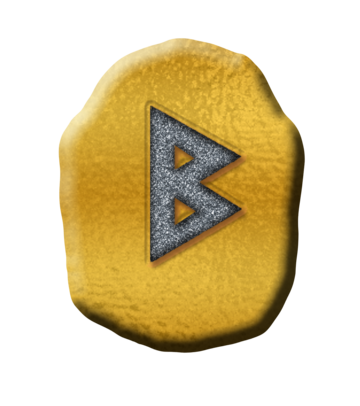
Berkano is the birch, the rune of new beginnings, fertility and protective care. It announces growth – a beginning, a healing, a sheltered becoming. Tend today, with patience and gentleness, what has tenderly begun, and it will thrive strongly.
‘Berkano/Bjarkan’ is the birch – the first tree to bud after winter. Rune of growth, fertility and new beginnings.
The Old Norse poem describes the birch as a greening branch, the smallest tree with the finest leaves. The Old English praises it as a beautiful, densely leaved tree.
The birch was an emblem of spring and of female, nourishing power. In clearings and on young ground it is often the first tree – a pioneer of new life.
Birch bark served as writing material in the North: even medieval runic and everyday letters have survived on it.
Beorc byþ bleda leas, bereþ efne swa ðeah tanas butan tudder, biþ on telgum wlitig, heah on helme hrysted fægere, geloden leafum, lyfte getenge.The birch bears no fruit; yet without seed it brings forth shoots, is fair in its branches, high in its crown gloriously adorned, laden with leaves, close to the sky.Old English Rune Poem, st. 18 · trans. after Dickins 1915 (public domain)
The Icelandic poem: „Birch is a leafy twig and a little tree and a fresh young shrub." Always it is about growth from itself – the birch as an image of new beginnings and care.
Proto-Germanic *berkanan „birch". Old Norse björk, Old English beorc, German „Birke". The birch is the pioneer tree of the North – the first to reclaim bare land; hence its sense of new beginning and fertility.
As the sound /b/ Berkano is common. It survived as Bjarkan into the Younger Futhark, standing there for the soft plosive b/p. Its double-bow form is among the most stable rune shapes.
Berkano shows how closely rune names are bound to the lived world: a tree everyone knew becomes the sign of becoming and growth. The reading is constant across the rows (Dickins; Barnes).
Rune-poem quotation: Old English Rune Poem after Bruce Dickins, Runic and Heroic Poems (Cambridge 1915, public domain); Norse stanzas after the Norwegian and Icelandic Rune Poems. Interpretation & etymology after R. I. Page (Runes), Michael Barnes (Runes – A Handbook) and Klaus Düwel (Runenkunde). Where name or meaning is disputed, it is noted in the text. In depth: runology overview.