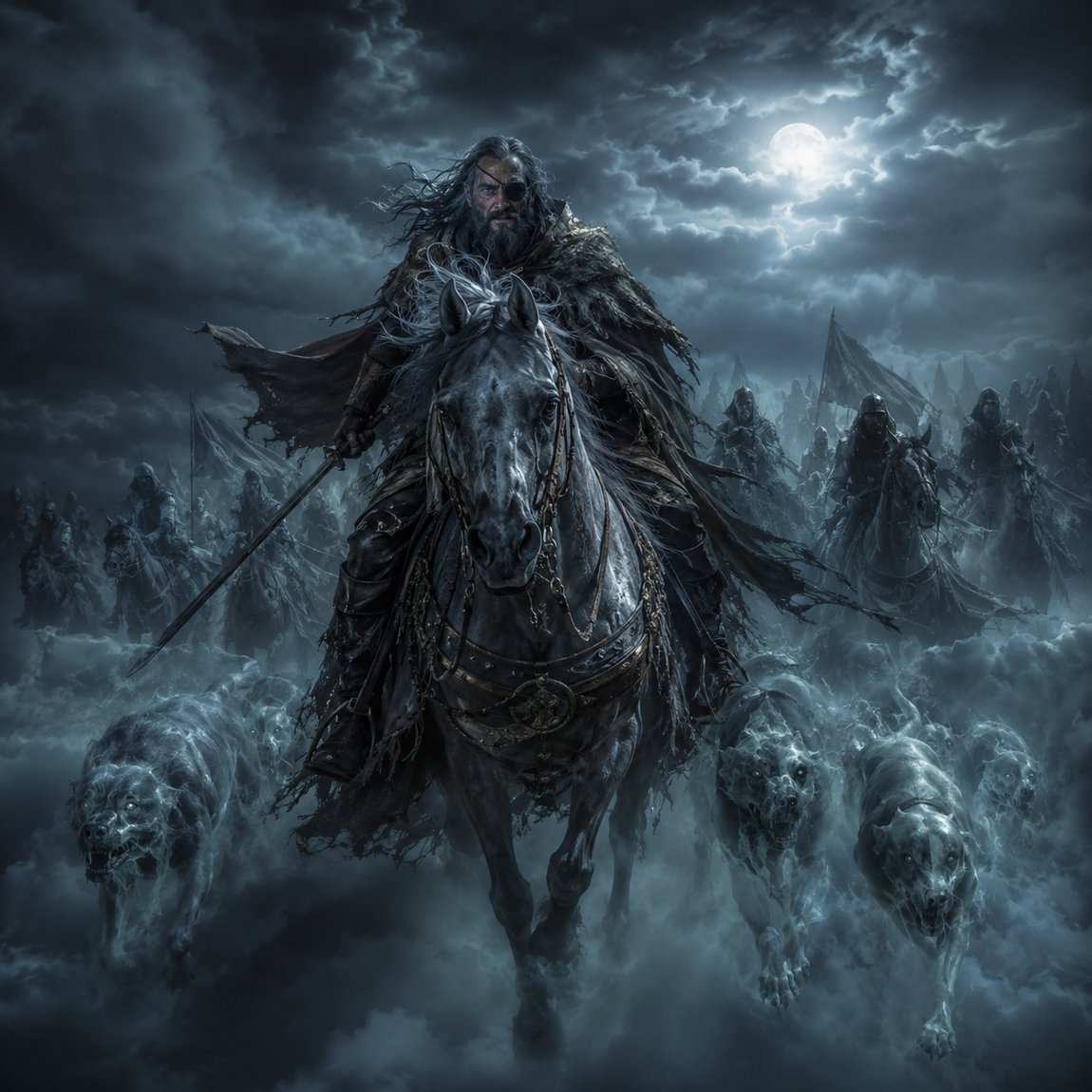
When in deepest winter the storm howls, so people believed, a spectral host rides through the night: the Wild Hunt. At its head rides a one-eyed huntsman on a grey steed – Odin himself. It is one of the most enduring legends of all, alive from the far North down to the Eifel.
In the North the phenomenon is called Oskoreia („Asgardreia“, the ride of the Asgard host) or Julereia. In Germany it is known as the Wild Hunt or the Raging Host – led by Wotan (the continental Odin), and in later folk belief by figures such as Frau Holle or anonymous „wild huntsmen“. The time of the hunt is the Yuletide nights (Raunächte) between the Yule feast and Epiphany, when the boundary between the worlds is thin.
The hunt is a host of the dead: fallen warriors, restless souls, hounds and steeds that roar through the air with a great din. Whoever meets it does well to throw themselves flat on the road and keep silent. Some tales tell that anyone who answers cheekily or laughs along is swept up, or has a piece of carrion thrown to them that turns to gold by morning – or the other way round. At the same time the ride counted as a blessing: where the hunt passes over the fields, the coming year will be fruitful.
„Wôdan rides in the Twelve Nights –
hear the storm, then shut the door.“
— after German folk belief (rendered in sense, handed down in the public domain)
Across Germany the Wild Hunt bears a different name in almost every landscape. In the north it is the “Raging Host” or “Wode's Host” – after Wodan, the old god of storm and the dead, who rides at its head. In Hesse and Thuringia Frau Holle pushes to the front, in the Bavarian-Austrian Alps Perchta. Sometimes the leader is a god, sometimes a woman, sometimes a damned huntsman condemned to race through the air forever.
However varied the names, the core is the same: a host that storms across the land in the dark season – a din of wind, baying hounds and hoofbeats. Whoever meets it should throw themselves flat on the ground or lie down in the wagon-rut and keep silent. Curiosity, mockery or a rash word can cost dearly.
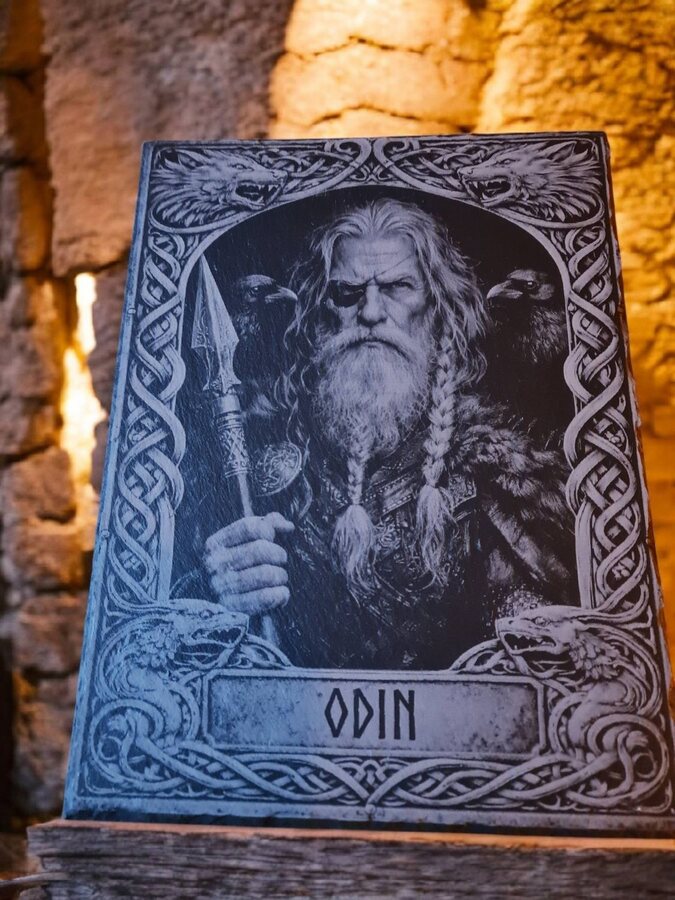
That of all figures Wodan should lead the host is fitting: Odin is the lord of the slain, who rides with his warriors, the god of storm and ecstasy. Jacob Grimm made this connection famous in his “Deutsche Mythologie” (1835) and drew the many regional legends together into one great picture.
In honesty one must say: much of this is 19th-century interpretation. The legends themselves are colourful and inconsistent; it was Grimm and Romanticism that turned the local “raging host” into the one Germanic Wodan myth. The folk belief in a host of the dead in the storm is old and genuine – the neat equation “Wild Hunt = cult of Odin” is younger than it sounds.
The Wild Hunt is one of the few legends truly known all across Germany: from the northern plain over the Harz and the Thuringian Forest into the Alps. The Rhineland and the Eifel too – our home region – know the nightly host and the “eternal huntsman” who finds no rest. Almost every district has its own sunken lane, its ridge, its wood through which the host rides.
Its high season is the Rauhnächte, the twelve nights around the winter solstice – exactly the time when, by old belief, the border between the worlds is thinnest. So the Wild Hunt belongs to the firm stock of German winter custom: a piece of shared, often forgotten home that rides through our storms to this day.
Odin (Wotan) · The Harii – the ghost host · Valhalla & the Einherjar · The Germanic tribes · Blót calendar & Yuletide nights.
Jacob Grimm, Deutsche Mythologie (1835, public domain). Peterborough Chronicle (1127). Norwegian Oskoreia tradition. German public-domain Edda translation: Karl Simrock (1851). Scholarship: Rudolf Simek, Dictionary of Northern Mythology; critical on the continuity question: Walter Pohl and others. Regional legends: Rhenish and Eifel legend collections of the 19th century.